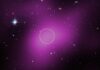
Scientists have released the most detailed map ever created of the region surrounding the Milky Way’s central black hole, Sagittarius A*. The data, gathered by the Atacama Large Millimeter/submillimeter Array (ALMA) in Chile, spans 650 light-years and provides an unparalleled view into the dense, turbulent conditions of the Central Molecular Zone (CMZ). This region isn’t just an oddity; it closely resembles the chaotic environments of the earliest galaxies, offering a unique window into the universe’s infancy.
The Central Molecular Zone: A Galactic Nursery and Graveyard
The CMZ is a sprawling collection of dense gas clouds, supersonic flows, and rapidly evolving stars. It holds roughly 80% of the Milky Way’s dense gas, making it the hottest, densest, and most turbulent area in our galaxy. This environment supercharges star formation in some regions while strangely suppressing it in others, a contradiction scientists are now equipped to study with unprecedented clarity.
The ALMA observations – the largest single image the telescope has produced since 2013 – capture not just broad structures but also individual stars whirling around the galactic center, revealing “rare and enigmatic” features that challenge current understanding. By analyzing gas movement, velocity, and chemical composition, researchers hope to decipher how these extreme conditions drove the Milky Way’s early evolution and, by extension, the development of the ancient universe.
A Molecular Inventory of Galactic Extremes
The survey, led by the ACES (ALMA CMZ Exploration Survey) collaboration involving over 160 scientists, has already identified more than 70 types of molecules within the CMZ. These range from simple compounds like silicon monoxide to complex organic molecules such as ethanol and methanol. Mapping these molecules allows scientists to trace how shock waves from colliding gas clouds affect heat, motion, and chemical makeup across the region.
This is not merely cataloging ingredients; it’s building a 3D map of the CMZ to reveal how different structures connect and influence star formation and destruction. The region is home to some of the most massive stars in the galaxy, which burn brightly and end their lives in spectacular supernovae, enriching the galactic environment with heavy elements.
Unexplained Anomalies Hint at Deeper Mysteries
Among the most intriguing discoveries is a structure called the Millimeter Ultra-Broad Line Object (MUBLO). This compact, dusty object emits strongly at millimeter wavelengths but remains invisible to other telescopes. Its fast-moving gas and unusual characteristics don’t match any known space object, suggesting the presence of previously unknown phenomena.
Studying anomalies like MUBLO could unlock crucial insights into extreme environments that are too distant to observe directly. The CMZ, in this sense, acts as a local laboratory for understanding the universe’s earliest and most violent epochs.
The ACES survey is just the beginning. With even more powerful telescopes coming online, our understanding of the galactic center – and, by extension, the early universe – is poised for a dramatic leap forward. This region’s chaotic nature holds keys to understanding not just how galaxies evolve, but how the first stars lived and died after the Big Bang.