



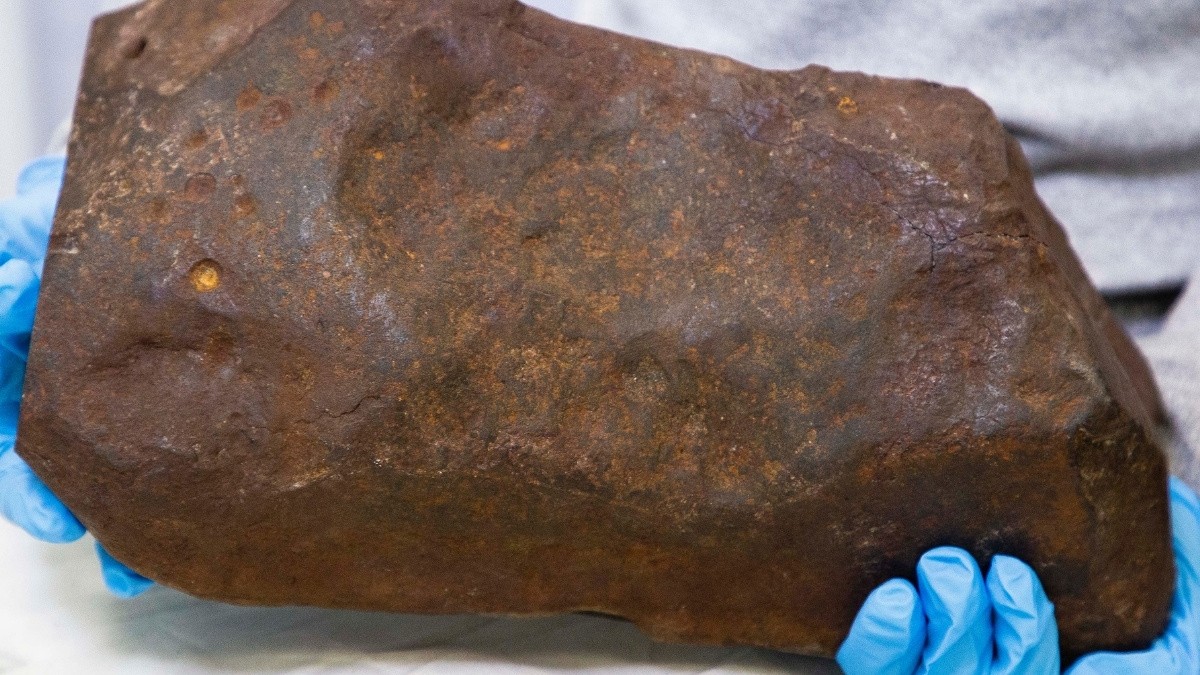
For years, David Hole of Maryborough, Australia, stubbornly believed a heavy, reddish rock he found in 2015 held a gold nugget inside. Despite relentless attempts to crack it open with saws, grinders, drills, and even acid, the rock remained stubbornly intact. What Hole didn’t know was that his persistence wasn’t about to reveal gold—but something far rarer and scientifically invaluable.
A Misidentified Treasure
The Maryborough region, part of the historic Australian goldfields, naturally led Hole to suspect a hidden fortune. But when the rock finally reached the Melbourne Museum for identification, geologist Dermot Henry recognized its unique sculpted surface – a telltale sign of atmospheric entry. Henry, having examined thousands of rocks over 37 years, confirmed it was one of only two genuine meteorites he’d encountered.
A 4.6-Billion-Year-Old Discovery
The meteorite, officially named “Maryborough,” weighed an astounding 17 kilograms (37.5 pounds). Once researchers carefully cut a slice, they determined it was an H5 ordinary chondrite, rich in iron and containing crystallized metallic droplets called chondrules. This composition and age – 4.6 billion years – make it significantly more valuable to science than gold.
Why this matters: Meteorites aren’t just space rocks; they’re time capsules. They provide direct evidence of the early Solar System, revealing clues about planet formation, elemental origins, and even the building blocks of life. Unlike gold, which is a resource, this meteorite represents knowledge itself.
From Asteroid Belt to Earth
Scientists believe the Maryborough meteorite originated in the asteroid belt between Mars and Jupiter, dislodged by collisions before eventually landing on Earth between 100 and 1,000 years ago. Historical meteor sightings from the late 19th and early 20th centuries may even correspond to its arrival.
Context: The Solar System formed from a swirling disk of dust and rock. Planets coalesced, but countless leftovers remained in the asteroid belt, occasionally crashing into Earth. Studying these impacts helps us understand the early history of our planet and the distribution of materials throughout the Solar System.
A Rare Find
The Maryborough meteorite is only the 17th confirmed meteorite found in Victoria, Australia, and the second-largest chondritic mass ever identified in the state. Its discovery is remarkable given the sheer number of gold nuggets found in the region.
“This is only the 17th meteorite found in Victoria, whereas there’s been thousands of gold nuggets found,” Henry told Channel 10 News. “Looking at the chain of events, it’s quite, you might say, astronomical it being discovered at all.”
The Maryborough meteorite is a reminder that the most valuable treasures aren’t always what we expect. The relentless pursuit of gold yielded something far more extraordinary – a piece of the universe itself.
This meteorite isn’t just a rare find; it’s a testament to the enduring value of scientific curiosity and the unexpected discoveries that await those who keep looking.