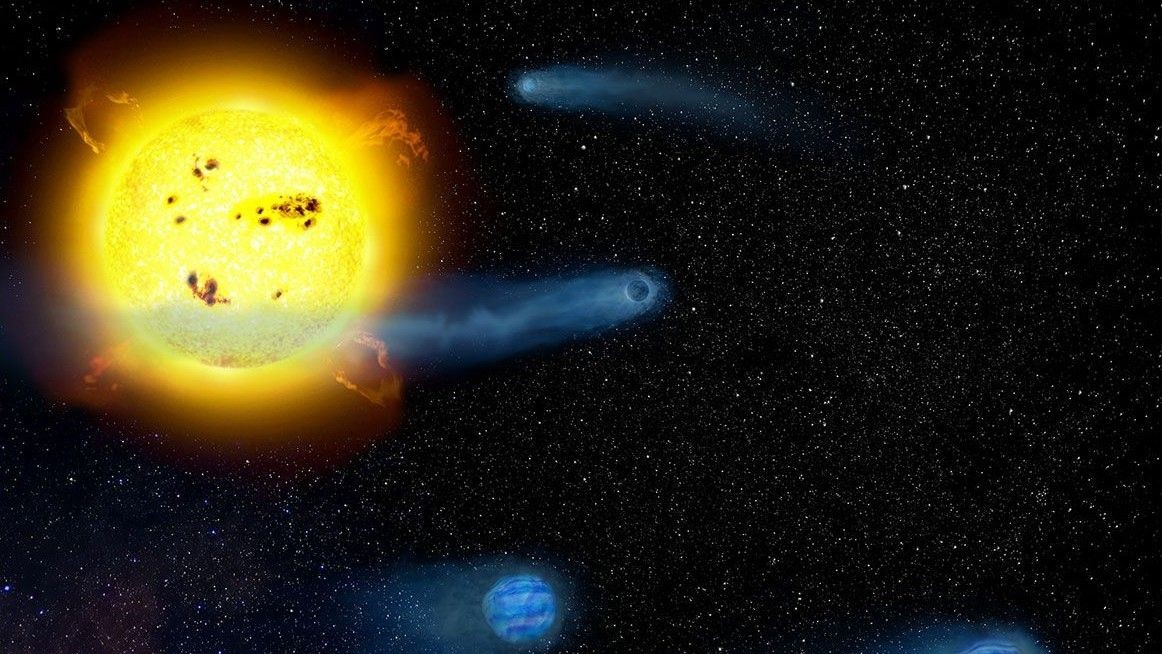
Astronomers have observed a rare planetary system in its early stages of development, revealing that young planets actually lose density as they age. The system, V1298 Tau, hosts four planets orbiting a star just 20 million years old—a blink of an eye in cosmic terms, compared to our sun’s 4.5 billion years. This discovery provides crucial insights into how common planetary configurations arise, particularly the super-Earths and sub-Neptunes that dominate the Milky Way but are absent from our own solar system.
The “Missing Link” in Planet Formation
For years, astronomers have puzzled over how planets between the sizes of Earth and Neptune end up in close orbits around stars. The V1298 Tau system offers a snapshot of this process, capturing planets in their formative years before they fully settle into stable configurations.
“What’s so exciting is that we’re seeing a preview of what will become a very normal planetary system,” says study lead author John Livingston.
The planets are unusually lightweight—almost like Styrofoam—meaning they have very low densities. Over time, these bloated worlds are expected to shed their thick atmospheres, becoming denser super-Earths and sub-Neptunes.
How the Discovery Was Made
The planets were first spotted in 2019 by NASA’s Kepler telescope, but their precise properties remained unknown. Researchers spent nearly a decade tracking the planets as they passed in front of their star (a technique called transit observation), measuring dips in starlight to determine their size and orbital period.
A key breakthrough came when ground-based telescopes detected an additional transit of the outermost planet, allowing scientists to refine its orbit and model the system’s gravitational interactions. The team then used this data to calculate the planets’ masses, revealing that they are far less dense than expected.
Implications for Planetary Evolution
The findings suggest that young planets evolve more quickly than previously thought, losing mass and shrinking faster than standard models predict. This means that the early stages of planetary development are more chaotic than once believed, with atmospheres shedding rapidly under certain conditions.
Over billions of years, these “puffy” planets will continue to contract, transforming into the compact super-Earths and sub-Neptunes common throughout the galaxy. By observing this process firsthand, astronomers can test and refine theories about how planetary systems evolve.
This discovery underscores the dynamic nature of planet formation, challenging older assumptions about how common planetary configurations emerge. The V1298 Tau system provides a vital benchmark for understanding the evolution of worlds beyond our own.