New research from NASA’s Goddard Space Flight Center indicates that the abundance of organic molecules detected in Martian mudstone is higher than can be easily explained by non-biological processes alone. The study, published in Astrobiology, suggests that ancient Mars may have once supported life, though researchers emphasize this remains a hypothesis requiring further confirmation.
The Discovery in Gale Crater
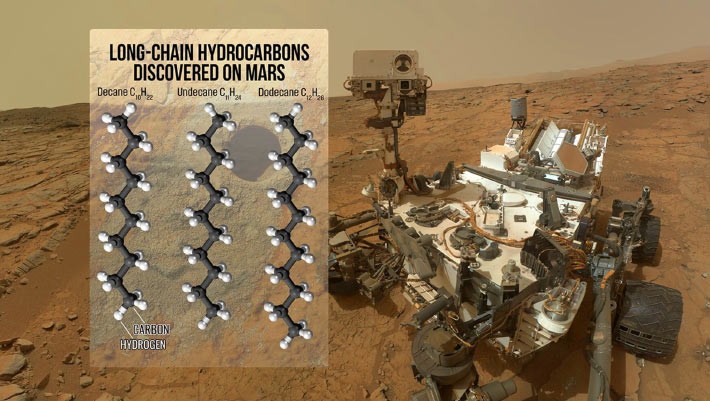
In 2025, NASA’s Curiosity rover detected long-chain alkanes – organic compounds – within the ancient Cumberland mudstone in Gale Crater. Initial analysis attributed these to thermal breakdown of fatty acids during laboratory testing. However, the latest study argues that these measurements likely represent a significant underestimate of the original organic material.
Rewinding the Clock: Radiation and Decay
Researchers used a combination of laboratory experiments, mathematical modeling, and Curiosity data to estimate how much organic material existed before millions of years of exposure to cosmic radiation degraded it. Their calculations suggest the mudstone originally held between 120 and 7,700 parts per million of alkanes or their precursor fatty acids – far exceeding levels typically produced by abiotic (non-biological) means.
Ruling Out Non-Biological Sources
The team systematically assessed potential non-biological origins for the compounds. They found that:
- Meteorite delivery and interplanetary dust would not have deposited sufficient quantities, given sedimentation rates and the difficulty of dust penetrating solid rock.
- Atmospheric haze, though possible, would have required methane-rich conditions unlikely to have existed on early Mars.
- Hydrothermal reactions – while capable of producing organic molecules – didn’t align with the mineral composition of the Cumberland mudstone, which shows no evidence of the high temperatures required for these reactions.
The Biosphere Hypothesis
The researchers acknowledge the need for extraordinary evidence to claim life on another planet. Nevertheless, they propose that an ancient Martian biosphere remains a plausible explanation for the observed organic abundance. The concentrations detected are consistent with what could be produced by biological activity, though alternative abiotic sources cannot be entirely ruled out.
“The certainty of life detection beyond Earth will require multiple lines of evidence,” the authors state, echoing the rigorous standards of astrobiological research.
Conclusion
The new study does not prove that life once existed on Mars, but it does raise compelling questions about the planet’s past habitability. The unexpectedly high concentrations of organic molecules in the Cumberland mudstone are difficult to explain without considering the possibility of an ancient Martian biosphere. Further investigation, including future sample-return missions, will be crucial to definitively determine the origin of these compounds.