


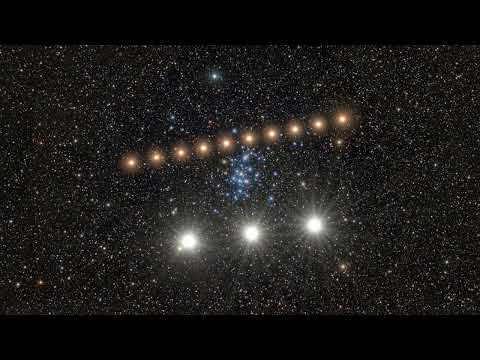
Skywatchers in the Southern Hemisphere witnessed an extraordinary sight in 2025: the planets Mars and Venus appeared to traverse the Beehive Cluster (Messier 44), creating striking dotted paths through the dense field of starlight. This composite time-lapse photograph, captured by astrophotographer Petr Horálek, beautifully illustrates this rare celestial event.
A Months-Long Alignment
The image isn’t a single night’s view; it’s a carefully constructed composite. Mars traced its path through the Beehive from late April to early May 2025, while Venus followed months later, making a brief appearance from late August to early September. The separate apparitions required weeks of dedicated observation and assembly.
What Makes the Beehive Special?
Messier 44, also known as Praesepe, is a prominent open cluster containing approximately 1,000 stars located about 600 light-years from Earth in the constellation Cancer. It’s one of the closest and most densely packed open clusters visible from our planet. This makes it an ideal “canvas” for planetary alignments, where bright planets seem to move against a backdrop of distant stars.
Why This Matters
The apparent motion of planets relative to the stars is a fundamental observation in astronomy. The word “planet” itself derives from the ancient Greek term for “wanderer,” reflecting this perceived movement. However, seeing a visual track like this – where planets are demonstrably in different positions night after night – makes this abstract concept concrete.
The Beehive’s proximity to the ecliptic (the plane of the solar system) makes it a frequent meeting point for planets. The conjunction of Mars and Venus in the same year serves as a vivid reminder that these celestial bodies share a common orbital neighborhood, and that certain deep-sky objects are positioned to create these dramatic alignments.
This composite image underscores the dynamic nature of our solar system, revealing how planets move in relation to distant star clusters. It’s a testament to the beauty and precision of celestial mechanics.


