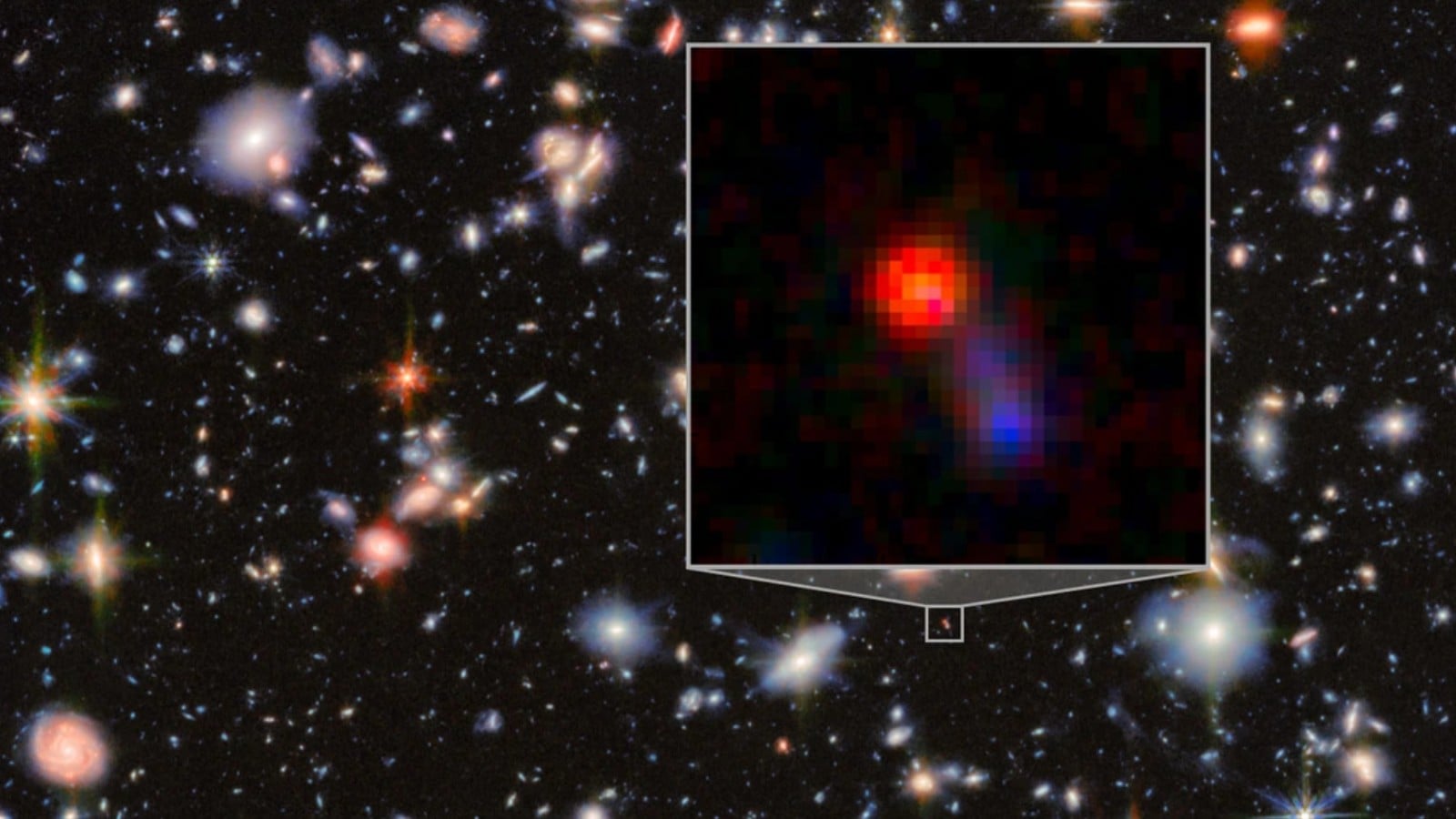
The James Webb Space Telescope (JWST) has uncovered a dramatic transformation in the galaxy “Virgil,” exposing a hidden supermassive black hole that defies current understanding of galactic development. This discovery suggests that black holes may actually drive galactic evolution, rather than the other way around, and hints at a population of similarly obscured cosmic “monsters” lurking in the early universe.
A Two-Faced Galaxy: The Jekyll and Hyde Effect
Virgil, observed approximately 600 million years after the Big Bang, appears benign in ultraviolet and visible light: a standard young galaxy quietly forming stars. However, when viewed through JWST’s Mid-infrared Instrument (MIRI), the galaxy reveals its darker side – a heavily obscured supermassive black hole consuming matter at an extraordinary rate. This black hole is unusually massive for its host galaxy, suggesting it grew faster than the galaxy itself, a phenomenon previously considered unlikely.
“JWST has shown that our ideas about how supermassive black holes formed were pretty much completely wrong,” says George Rieke of the University of Arizona. “It looks like the black holes actually get ahead of the galaxies in a lot of cases.”
This discrepancy challenges prevailing theories that galaxies and their central black holes co-evolve. The discovery implies that some black holes may have taken the lead in early cosmic development, influencing the growth and structure of their host galaxies.
The Mystery of the ‘Little Red Dots’
Virgil belongs to a class of early galaxies known as “Little Red Dots.” These objects, first identified by JWST, were abundant around 600 million years after the Big Bang but seem to vanish by the time the universe reaches 2 billion years old. This disappearance is a major puzzle in cosmology. By studying Virgil, astronomers hope to trace the fate of these early galaxies and understand why they faded from view. The possibility exists that they transformed into different types of galaxies, and the JWST is now helping to identify their modern descendants.
Infrared Vision Unveils the Hidden Truth
The key to uncovering Virgil’s true nature lies in infrared observation. While dust clouds effectively block ultraviolet and visible light, infrared radiation penetrates these barriers, revealing the intense energy output of the black hole at the galaxy’s core. MIRI allows scientists to see beyond the “mild-mannered” facade, exposing the ravenous activity hidden within.
“MIRI basically lets us observe beyond what UV and optical wavelengths allow us to detect,” explains Pierluigi Rinaldi of the Space Telescope Science Institute. “It’s easy to observe stars… But there’s something more than just stars, something that only MIRI can unveil.”
This suggests that many more dust-obscured supermassive black holes may exist undetected throughout the early universe, potentially playing a larger role in galactic evolution than previously estimated.
Implications for Understanding the Early Universe
The discovery of Virgil raises a critical question: are we missing an entire population of cosmic “monsters” simply because our current observation methods allow them to hide in plain sight? As JWST continues to scan deeper into the cosmos, it may reveal that these hidden behemoths are far more common than expected, rewriting our understanding of how galaxies and black holes interact and evolve. The JWST’s ongoing observations promise to strip away these cosmic disguises and reveal a more complete, and possibly terrifying, picture of the early universe.