Comet C/2024 E1 (Wierzchos) will reach its closest point to the sun today, January 20th, in a phenomenon called perihelion. This means it will pass within approximately 52.6 million miles (84.6 million km) of our star—a bit more than half the distance between Earth and the sun. This proximity is expected to temporarily brighten the comet, though it won’t be visible to the naked eye.
Why Perihelion Matters
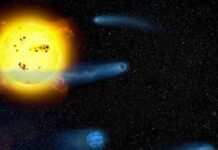
Perihelion isn’t just about brightness; it’s a critical moment for comets. The sun’s intense heat causes the comet’s icy core to vaporize, releasing gas and dust that form the coma (the fuzzy atmosphere around the nucleus) and the iconic tail. The solar wind then sculpts this material into the comet’s distinctive shape.
This process is essential for understanding comet composition. As they approach the sun, comets reveal what they’re made of – a glimpse into the early solar system’s building blocks.
Visibility and Viewing Opportunities
While C/2024 E1 (Wierzchos) won’t be naked-eye visible (peak magnitude around +8.1), stargazers with small telescopes may catch a glimpse. The comet is currently traveling through the southern constellation Microscopium, making it difficult to observe from the U.S. during nighttime hours.
However, another opportunity will arise on February 17th, when the comet makes its closest approach to Earth (perigee) at around 93 million miles (1 AU). At this point, it might be faintly visible low on the southwestern horizon at sunset for observers in the U.S., though at a dimmer magnitude of +8.9.
Discovery and Composition
Discovered in March 2024 by the NASA-funded Catalina Sky Survey, C/2024 E1 (Wierzchos) likely originated from the distant Oort Cloud – a vast reservoir of icy bodies surrounding our solar system.
Recent observations from the James Webb Space Telescope reveal an unusual lack of cobalt in the comet’s composition. This suggests that cobalt may have been lost during the early stages of its formation, potentially expelled by the gravitational influence of giant planets. This finding is significant because it challenges existing models of planet formation and the distribution of elements in the early solar system.
The discovery of missing cobalt in this comet raises fundamental questions about how the planets formed and where certain elements ended up.
In conclusion, while C/2024 E1 (Wierzchos) won’t deliver a spectacular naked-eye show, its perihelion and composition reveal valuable insights into the dynamic processes shaping our solar system. The comet’s journey offers a rare glimpse into the origins of icy bodies and the chemical evolution of our cosmic neighborhood.