



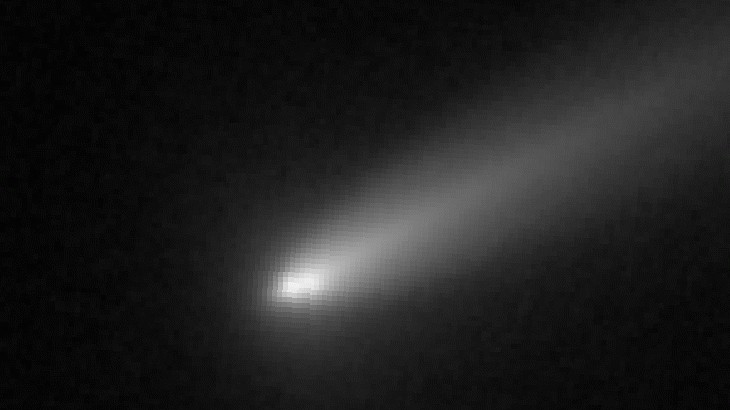
A recently discovered comet, dubbed “other ATLAS,” has disintegrated in spectacular fashion, offering a rare glimpse into the violent end of these icy celestial bodies. New images reveal the comet breaking apart into fragments after a close encounter with the sun earlier this month.
Discovery and Unusual Brightness
Comet C/2025 K1 (ATLAS) was first observed in May by the Asteroid Terrestrial-impact Last Alert System (ATLAS) telescope network. It reached its closest point to the sun on October 8, passing within 31 million miles. The comet gained attention for developing a striking golden glow in its coma and tail – a phenomenon seen in only a few comets due to its unusual composition, lacking common carbon-based molecules like dicarbon and cyanide.
Sudden Disintegration
On November 13, astronomers detected the comet splitting into multiple pieces. Astrophotographer Michael Jäger documented the disintegration with a timelapse animation showing the fragments drifting apart. The comet was predicted to break up due to the intense gravitational stress of its solar flyby, and initial observations after perihelion suggested it survived. However, a sudden brightening event preceded the fragmentation into at least four distinct pieces.
The Significance of the Breakup
The ATLAS network, funded by NASA, has discovered dozens of comets since 2015, including several notable ones that have made headlines in recent years. This latest fragmentation highlights the fragility of comets as they approach the sun, providing insights into their internal structure and composition. The unusual golden hue of this comet suggests a unique chemical makeup, potentially revealing clues about the early solar system’s conditions.
The Other ATLAS: An Interstellar Visitor
This event also draws attention to another comet sharing the ATLAS name: 3I/ATLAS, an interstellar object ejected from another star system. Unlike C/2025 K1, 3I/ATLAS is traveling through our solar system, not around it, and will reach its closest point to Earth on December 19. Despite speculation, astronomers confirm it is not an alien spacecraft.
The destruction of C/2025 K1 serves as a reminder of the dynamic and often violent processes shaping our solar system, while the continued observation of 3I/ATLAS offers a rare opportunity to study an object from beyond our cosmic neighborhood. The fragments of C/2025 K1 remain visible in the constellation Leo for amateur astronomers with telescopes or binoculars.