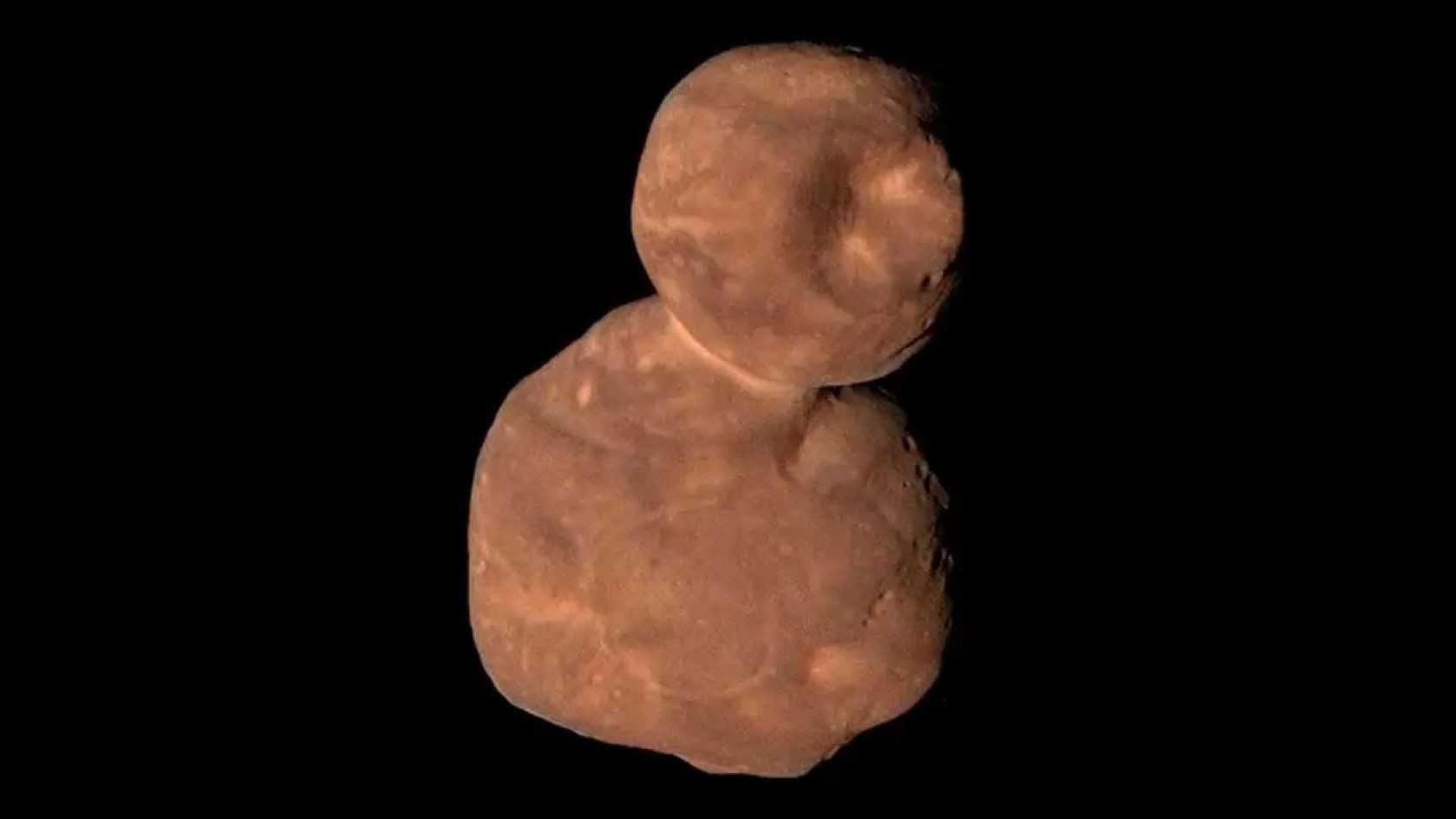
The outer solar system is populated by a peculiar class of icy objects nicknamed “space snowmen” – planetesimals composed of two conjoined spheres. A new study from Michigan State University offers a plausible explanation for their formation, suggesting they arise not from violent collisions, but from gentle mergers within swirling clouds of cosmic dust.
The Mystery of Contact Binaries
Beyond Neptune, in the frigid expanse of the Kuiper Belt, lie remnants from the solar system’s early days: planetesimals. These icy building blocks likely formed within rotating disks of dust and pebbles orbiting the young sun. In 2019, NASA’s New Horizons mission provided the first close-up views of these snowman-like structures, known as contact binaries. Estimates suggest between 10% and 25% of planetesimals in this region may exhibit this dual-sphere configuration, but the precise mechanism behind their creation remained elusive.
Previous Theories Fell Short
Earlier attempts to model contact binary formation focused on direct collisions between planetesimals. However, those simulations consistently yielded perfectly spherical results, failing to explain the observed snowman shapes. The problem was the simplification of planetesimals as singular, large bodies rather than aggregates of smaller particles.
A New Approach: Simulating Particle Clouds
Researchers led by Jackson Barnes adopted a more computationally intensive approach. Instead of modeling collisions, they simulated planetesimals as clouds of individual pebbles resting on each other’s surfaces. This method allowed them to observe how these clouds behaved as they spun and coalesced.
The simulations revealed that, under certain conditions, the spinning clouds would split into two separate planetesimals before merging. These binary planetesimals then spiraled inward due to mutual gravitational attraction, gently fusing to form a contact binary. This model not only creates spherical shapes but also flat, cigar-shaped, and, crucially, snowman-shaped planetesimals, depending on the speed of the particles and the strength of their interlocking forces.
Long-Term Stability and Future Research
Once formed, these loosely connected pairs can remain stable for billions of years, as the vast distances in the outer solar system minimize the risk of disruptive collisions. Current simulations suggest contact binaries comprise roughly 4% of planetesimals, slightly lower than estimated. Barnes’ team believes increasing the complexity of their simulations, by adding more particles and size ranges, could refine the accuracy.
“This is something we’re currently investigating in greater detail, with specific respect to the creation of triple systems and their relation to the current observed population of relict triples in the Kuiper Belt.”
The research also hints at the potential for even more complex structures, such as triple planetesimal systems, which may explain some of the observed groupings in the Kuiper Belt. This model offers a clearer picture of how these unusual objects form and persist in the distant reaches of our solar system.