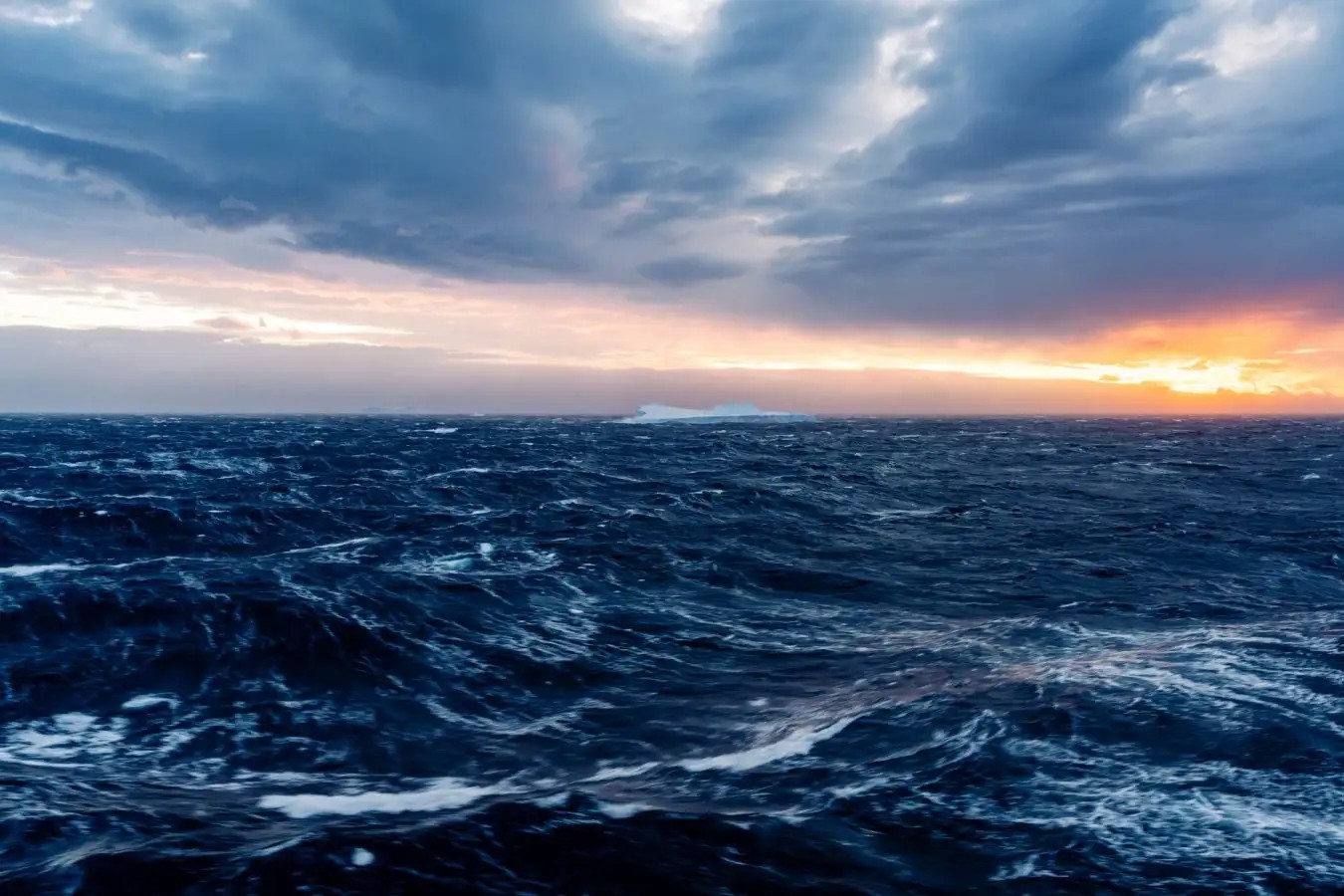
New scientific modeling warns that the collapse of a critical ocean current system could trigger a catastrophic feedback loop, releasing billions of tonnes of stored carbon into the atmosphere and accelerating global warming far beyond current projections.
The Threat to the “Global Conveyor Belt”
The Atlantic Meridional Overturning Circulation (AMOC) —a vital system of currents that includes the Gulf Stream—acts as a massive heat distributor for the planet. By carrying warm, salty water from the Gulf of Mexico to the North Atlantic, it regulates temperatures across Europe and the Northern Hemisphere.
However, this system is slowing down. Scientists believe that melting ice from the Greenland ice sheet is flooding the North Atlantic with fresh water. This dilution reduces water density, preventing the saltier water from sinking and driving the “conveyor belt” forward. Recent data indicates the AMOC has already declined by approximately 15%, with a total collapse possible within decades or centuries.
The Southern Ocean Connection
While much of the focus on AMOC has been on the cooling of Europe, new research from the Potsdam Institute for Climate Impact Research reveals a much more dangerous secondary effect occurring in the Southern Hemisphere.
If the AMOC shuts down, the disruption to global ocean circulation would alter salinity levels near Antarctica. This change would break down the natural layering of the ocean, allowing deep, cold water to rise to the surface—a process known as convection.
This deep water is a massive reservoir of carbon, accumulated over millennia from atmospheric absorption and the decomposition of organic matter. The study suggests this process could:
– Release up to 640 billion tonnes of CO2 near Antarctica.
– Increase global temperatures by an additional 0.2°C.
– Create a self-sustaining warming cycle that is difficult to stop.
A Climate of Extremes: Winners and Losers
The collapse of the AMOC would not result in uniform global changes; instead, it would create violent climatic shifts and “tipping points” across different regions:
- The North: The Arctic could see temperatures plummet by 7°C, potentially freezing vast areas of Canada, Scandinavia, and Russia.
- The South: Conversely, Antarctica could heat up by 6°C. This warming poses an existential threat to the East Antarctic Ice Sheet, which, if destabilized, could trigger dozens of meters of global sea-level rise.
- The Atmosphere: The release of carbon from the Southern Ocean would act as a massive “feedback loop,” where ocean changes drive atmospheric warming, which in turn causes more ice melt.
The “Commitment Time” Problem
One of the most alarming findings involves the concept of irreversibility. The study indicates that because current atmospheric CO2 concentrations (430 ppm) already exceed the 350 ppm threshold, an AMOC collapse may be impossible to reverse once it begins.
While the actual release of carbon from the deep ocean might take a millennium to fully play out, the window to prevent the initial collapse is much smaller. Experts warn that humanity’s current emission trajectories could “lock in” this collapse within the next 25 to 50 years.
“What matters is not the impact time, it is the commitment time,” warns co-author Johan Rockström. “It’s literally now.”
Conclusion
The potential collapse of the AMOC represents a profound “domino effect” where a disruption in the Atlantic triggers a carbon release in the Antarctic. This research highlights that the climate crisis is not just about gradual warming, but about the risk of hitting irreversible thresholds that could fundamentally reshape the planet’s habitability.