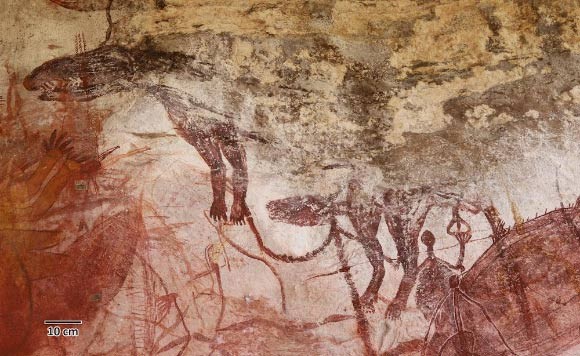
New rock art discoveries in northern Australia’s Northern Territory indicate that the Tasmanian tiger (thylacine) and Tasmanian devil persisted on the mainland for a surprisingly long time, potentially surviving into relatively recent history. Researchers have uncovered 14 previously undocumented depictions of the thylacine and two of the Tasmanian devil at sites in northwest Arnhem Land. Some of these paintings, made with ochre and pipe clay, may be less than 1,000 years old—challenging previous assumptions about their extinction timeline on the continent.
Evidence of Continued Survival
For decades, scientists believed these animals vanished from the Australian mainland around 3,000 years ago. Earlier estimates relied on limited findings: only 23 known Tasmanian devil and approximately 150 thylacine depictions in rock art across northern Australia. The latest findings dramatically increase the number of known thylacine images, suggesting a more significant cultural and ecological role than previously understood.
The art styles vary, utilizing red, yellow ochre, and white pipe clay. The use of pipe clay is particularly telling, as it fades faster than ochre, implying that some paintings were made in the last millennium. This raises the question of whether the artists depicted animals they had actually seen.
Cultural Significance and Indigenous Knowledge
The thylacine appears to have been far more culturally important than the Tasmanian devil, with over 160 depictions compared to just 25 for the devil. This disparity suggests the thylacine held a deeper symbolic or practical relevance for Aboriginal communities.
The art also reveals that these animals were not simply relics of the distant past; they were actively remembered and represented across generations, with some paintings retouched over time. According to local oral histories, the thylacine was even linked to the Rainbow Serpent, an important figure in Aboriginal cosmology, and associated with water sources.
Contemporary Relevance
“These depictions show that the thylacine held a meaningful place in everyday life and local knowledge long before it went extinct,” stated Professor Paul Taçon, lead author of the study. “The thylacine lives on in western Arnhem Land not as a ghost from the past but as a meaningful creature that still has present-day significance.”
Co-author Joey Nganjmirra, a Djalama man from Western Arnhem Land, emphasized that ancestors recounted hunting with thylacines, underscoring their recent presence in the region. Contemporary Aboriginal artists continue to depict the thylacine on bark and canvas, calling it “Djankerrk”—a testament to its lasting cultural importance.
The new study, published in Archaeology in Oceania, provides compelling evidence that the thylacine and Tasmanian devil were integral parts of the Australian mainland ecosystem and Indigenous cultures for much longer than previously assumed. This discovery underscores the value of combining scientific analysis with traditional knowledge to paint a more complete picture of the past.