Uranium is messy.
When it stays locked inside rock, it sits there quietly. But mine activity or shifting chemistry can turn it soluble. Once dissolved, it drifts. Into groundwater. Away from the source. Spreading poison you can’t see.
That mobility is the real headache.
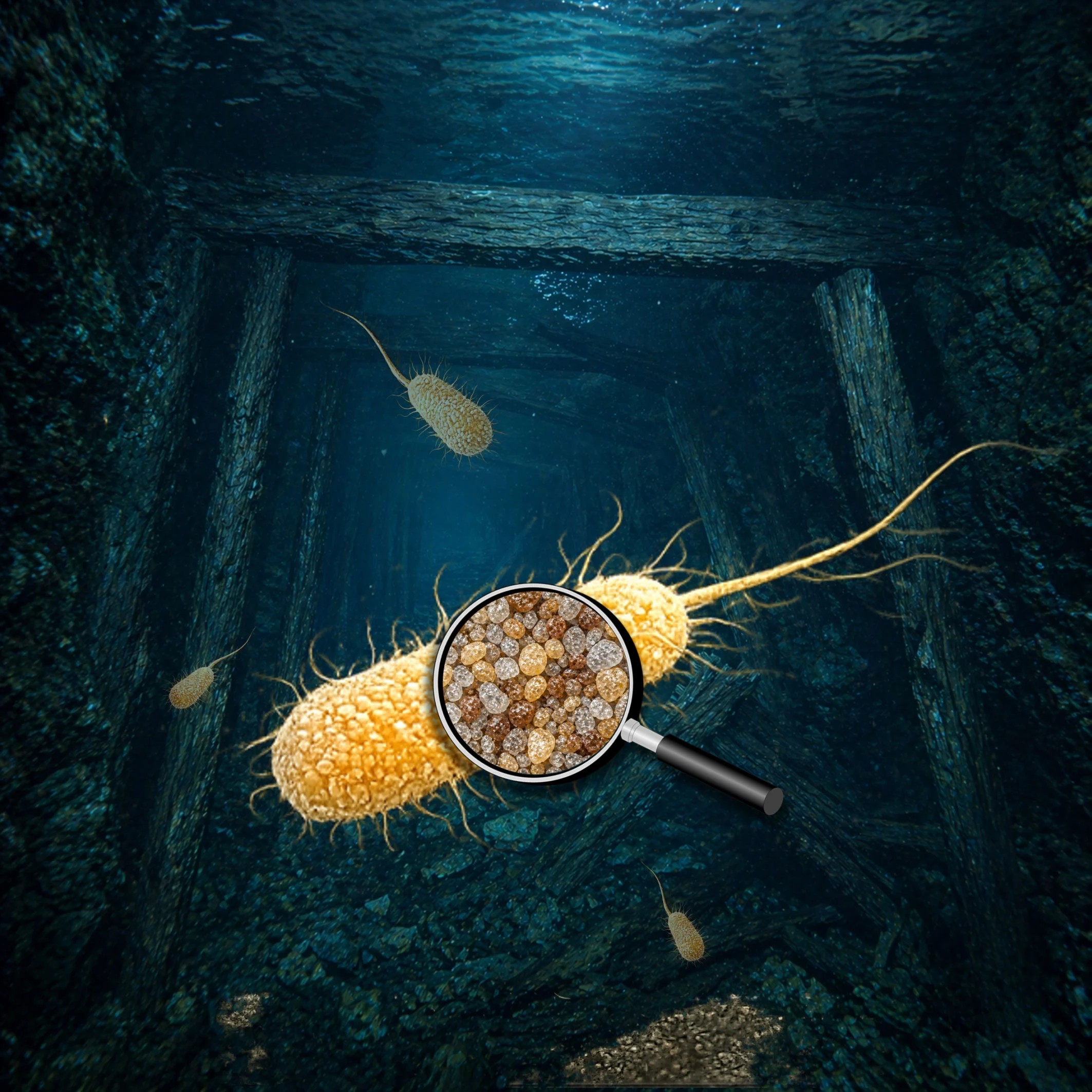
New research from the Helmholtz-Zentrum for Dresden-Rossendorf (HZBR), Wismut GmbH, and Granada University suggests a weird solution: bacteria. Specifically, the kind already hanging out in flooded uranium mines. They don’t just eat uranium. They convert it into a stubborn, stable compound that doesn’t want to move.
The Food Chain Trick
The trick involves glycerol.
You might know glycerol from cosmetics or biofuels. In this context it is fuel for microbes. Glycerol forms naturally when fungi break down wood or through fat metabolism in animals. The researchers fed this substance to bacterial samples taken from Wismut GmbH’s mine in Germany’s Ore Mountains.
Why glycerol?
“Bacteria can use uranium dissolved in water for metabolism when they have glycerol,” explains Dr. Evelyn Krawczyk-Barzs of HZBR’s Terrestrial Microbiology group. “Our previous work already showed they could metabolically utilize the toxic metal.”
The team wanted to see two things. First, how much uranium disappears from the water. Second, what form does it take when it’s gone?
They didn’t guess. They replicated the mine environment in the lab. Deep underground—about two thousand meters down—oxygen is scarce. The team stripped oxygen from the samples and added the glycerol.
Let nature take its course.
A Rare Oxidation State
After 130 days the results were stark.
Only 5 percent of the uranium remained in solution. The rest?
“You suspect it went into the cell walls,” says lead author Dr. Antonio M. Newman Portela. “Accumulation was expected.”
Standard theory says bacteria hoard heavy metals. We knew that part. But standard theory also says uranium exists in valency 4 or 6.
Valency 5?
Rare. Usually transient. Unstable. Like trying to balance a coin on its edge.
The team didn’t rely on chemical tests alone. They went to the European Synchrotron in France. Using the Rossendorf Beamline at the ESRF, they probed the atomic structure of the bacterial biomass.
The result defied expectations.
“Until now, pentavalent uranium was seen in unstable oxidation states,” Newman-Portela notes. “So finding a high proportion of U(V) in our samples was extremely surprising.”
It wasn’t just there. It was dominant.
Iron, Oxygen, and Patience
The pentavalent uranium didn’t exist alone.
It bonded with iron and oxygen to create FeU(V)O4. A new kid on the block. Literally. This specific compound lacks a common name because it’s so fresh to science. It first appeared in data from 2020. Researchers had analyzed Croatian soil contaminated by uranium ammo. They noticed something odd: the uranium wasn’t moving. Not even with air exposure.
It sat stable for 25 years.
But how did it form then? No one knew.
Now they have an idea.
Bacteria might be the missing link in creating this ultra-stable uranium sink.
Here’s the kicker.
When the researchers exposed dried bacterial biomass to oxygen, the amount of FeU(V)O4 actually increased. Oxygen usually dissolves or changes these compounds. Here? It seemed to help lock things down. Or at least sustain them.
Does that mean we can pump bacteria and glycerol into toxic sites?
Not yet.
Lab conditions are clean. Mines are dirty. The real world introduces variables you can’t control. Temperature. Flow rates. Other competing microbes. The compound lasts decades in Croatian soil. But will it hold up under constant hydrological pressure?
Krawczyk Barzs cautions against getting ahead of herself.
“We have to investigate whether this helps remediation,” she says.
It’s not a cure. It’s a mechanism.
We finally have a map for how some uranium gets stuck in nature. Bacteria eat the glycerol, process the uranium, and build a molecular cage around it using iron.
Maybe that cage stays closed.
Maybe it opens in five years.
That’s what the next studies will tell us. For now, the mine water stays quiet. And the uranium stays put. 🦠