Astronomers have unveiled an unprecedentedly detailed three-dimensional map of the early universe, revealing a vast network of faint light and gas between galaxies that has remained largely unseen in previous surveys. This breakthrough, achieved using data from the Hobby-Eberly Telescope Dark Energy Experiment (HETDEX), offers a new perspective on the universe’s formative period, known as “cosmic noon,” when star formation peaked roughly 9 to 11 billion years ago.
Mapping the “Sea of Light”
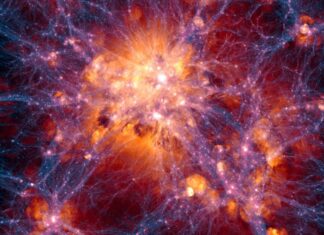
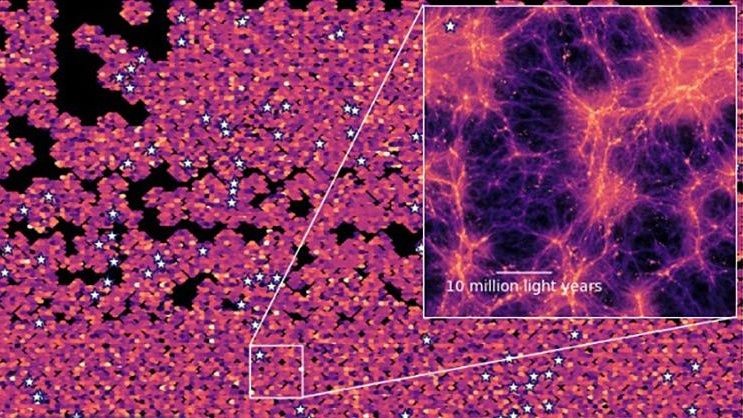
The map doesn’t just show galaxies—the bright “cities” of the cosmos—but also the diffuse glow of hydrogen gas and smaller, dimmer galaxies that lie in the spaces between them. This is significant because previous surveys largely focused on cataloging individual, bright galaxies, missing a critical component of the early universe’s structure. As lead author Maja Lujan Niemeyer explained, “There’s a whole sea of light in the seemingly empty patches in between.”
This “sea of light” is created by Lyman-alpha radiation, emitted when hydrogen atoms are energized by young, hot stars. It’s a characteristic signature of intense star formation, making it a key indicator of galactic activity during this crucial epoch. The study’s co-author, Robin Ciardullo, notes that this technique has allowed them to locate previously unknown faint galaxies and gas clouds.
Line Intensity Mapping: A New Approach to Cosmic Cartography
The researchers used a technique called Line Intensity Mapping (LIM) to create the map. Unlike traditional methods that identify galaxies one by one, LIM measures the combined light from hydrogen’s Lyman-alpha wavelength across vast regions of the sky. This allows them to trace not just bright galaxies but also the diffuse gas that surrounds and connects them, resulting in a “heat map” of cosmic illumination.
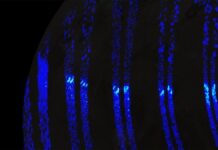
The map was constructed from an enormous dataset of over 600 million spectra collected by HETDEX, originally designed to measure the universe’s expansion and investigate dark energy. By repurposing this archive and leveraging supercomputers with custom programming, the team reconstructed a 3D view of hydrogen distribution across a massive cosmic volume. Gravity causes matter to cluster, so the team used the positions of known galaxies to interpret the fainter background glow, revealing previously undetectable structures.
Implications for Understanding Galaxy Formation
By charting hydrogen during the universe’s most active star-forming era, astronomers now have a clearer picture of how galaxies gathered gas, formed stars, and assembled into the large-scale structures we observe today. The research suggests that future cosmic surveys may increasingly rely on intensity mapping to reveal not just the brightest objects in the universe but the complete glowing framework that binds them together.
This study marks an exciting first step in using intensity mapping to understand galaxy formation and evolution, according to co-author Caryl Gronwall. The combination of advanced telescopes like the Hobby-Eberly Telescope with new complementary instruments is paving the way for a golden age of cosmic mapping, promising deeper insights into the universe’s origins and evolution.