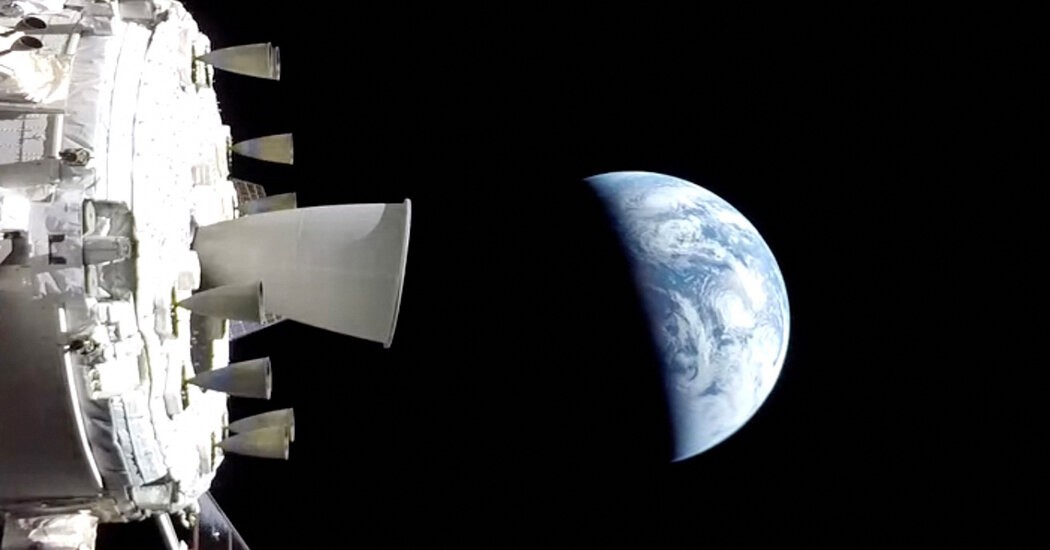
After 10 days in deep space and a journey covering nearly 700,000 miles, the crew of Artemis II is preparing for the most critical phase of their mission: re-entering Earth’s atmosphere. The mission, which marks the first crewed flight into deep space in over five decades, has been a series of historic milestones, technical hurdles, and record-breaking distances.
The Final Countdown: What to Expect During Splashdown
The return to Earth is a precision-timed sequence designed to transition the crew from the vacuum of space to the safety of the Pacific Ocean.
- Separation: At 7:33 p.m. ET, the Orion capsule (the crew module) will detach from the service module, which provides power and propulsion.
- Re-entry: At 7:53 p.m. ET, the capsule will hit the upper atmosphere at a staggering 24,000 mph.
- Deceleration: Friction from the atmosphere will slow the craft, followed by the deployment of parachutes to reduce speed from hundreds of miles per hour to a safe landing velocity.
- Splashdown: The crew is expected to land in the Pacific Ocean, west of San Diego, at approximately 8:07 p.m. ET.
Note on Viewing: While NASA will stream the return live starting at 6:30 p.m. ET via YouTube and X, the spacecraft itself will likely not be visible to observers on the California coast, as it will enter the atmosphere from the southwest over the ocean. However, a sonic boom from the high-speed re-entry may be heard in parts of Southern California.
A Mission of Firsts and Records
Artemis II has been defined by its “superlative” achievements, breaking barriers for both science and representation:
– Breaking Records: The crew surpassed the distance record set by Apollo 13 in 1970, traveling 252,756 miles from Earth—roughly 4,100 miles farther than the previous record.
– New Frontiers: The crew observed parts of the Moon’s far side that have never been seen by human eyes, capturing images of craters and plains to aid future lunar landings.
– Diverse Representation: The crew includes the first Black man to travel around the Moon (Victor Glover ), the first woman (Christina Koch ), and the first Canadian astronaut (Jeremy Hansen ).
Technical Challenges and the “Heat Shield” Debate
The mission was not without its growing pains. The crew had to manage communication glitches and even troubleshoot a malfunctioning toilet—a reminder that even in deep space, basic infrastructure is vital.
More significantly, the mission has highlighted a technical debate regarding the Orion heat shield. NASA has acknowledged flaws in the shield’s integrity but maintains that the mission’s trajectory was specifically designed to minimize risk and ensure astronaut safety. This has drawn scrutiny from some veteran engineers and former astronauts who argued the risks were too high for launch. Despite these concerns, the mission successfully demonstrated that Orion’s core life support and propulsion systems are capable of sustaining humans in deep space.
Mission Timeline Recap
| Phase | Key Events |
|---|---|
| Launch | April 1 from Kennedy Space Center; faced early IT and plumbing glitches. |
| Transit | Tested exercise equipment (flywheel) and CPR procedures in microgravity. |
| Lunar Orbit | Entered the Moon’s gravity; tested new orange emergency spacesuits. |
| The Flyby | Captured images of the lunar far side and witnessed a 53-minute solar eclipse. |
| The Return | Currently transitioning from the lunar sphere of influence back to Earth. |
Conclusion
The splashdown of Artemis II represents more than just the end of a 10-day journey; it is a successful proof-of-concept for long-duration human spaceflight. By navigating the technical complexities of deep space and the lunar environment, NASA has laid the essential groundwork for the next era of lunar exploration and eventual human missions to Mars.