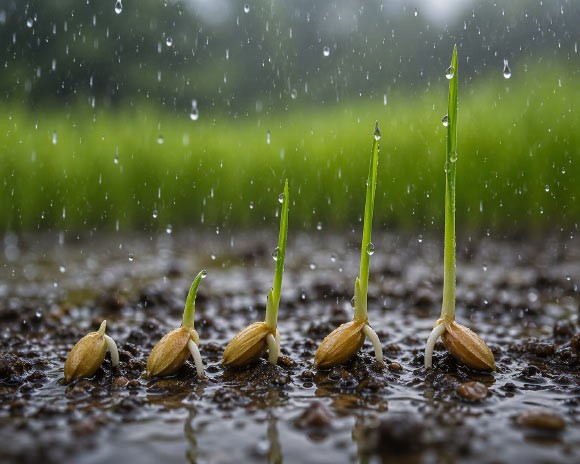
New research suggests that plants are far more attuned to their environment than previously thought. Recent experiments conducted by researchers at MIT have provided the first direct evidence that seeds can “hear” the acoustic vibrations of falling rain, using these sounds as a biological signal to accelerate germination.
The Mechanism of Sound Perception
While plants do not have ears, they are highly sensitive to physical stimuli. They respond to light (phototropism), touch (thigmotropism), and gravity (gravitropism). The study, published in Scientific Reports, focuses on how seeds use sound to navigate these environmental cues.
The key to this “hearing” lies in statoliths —dense particles within plant cells that act like tiny weights. In a process similar to sand settling at the bottom of a jar, statoliths sink to the bottom of a cell, signaling the direction of gravity and helping the plant orient its roots downward and its shoots upward.
The researchers discovered that the acoustic energy from raindrops is strong enough to physically jostle these microscopic statoliths. By vibrating these internal “sensors,” the sound of rain essentially “wakes up” the seed.
Experimental Findings: The Rice Study
To test this theory, Professor Nicholas Makris and researcher Cadine Navarro conducted extensive experiments using approximately 8,000 rice seeds. Rice is an ideal subject for this study as it naturally grows in shallow, watery environments where rain-induced vibrations are common.
The team utilized a controlled setup to mimic various weather conditions:
– Variable Stimuli: They adjusted the size and height of water droplets to simulate light, moderate, and heavy rainstorms.
– Acoustic Verification: Using hydrophones, they confirmed that the vibrations generated in the lab matched the acoustic profiles of real-world rain in ponds, wetlands, and soil.
– Growth Acceleration: The results were striking. Seeds exposed to the sound of falling water germinated 30% to 40% faster than those kept in identical conditions without the acoustic stimulus.
The study also noted a correlation between depth and sensitivity: seeds closer to the water’s surface responded more vigorously to the sound, growing faster than those buried deeper.
Why This Matters for Survival
This discovery explains the evolutionary logic behind the behavior. For a seed, sensing rain is a high-stakes calculation of survival.
“Our study has shown that these same mechanisms seem to be providing plant seeds a means of perceiving submergence depths in the soil or water that are beneficial to their survival by sensing the sound of rain,” noted Professor Makris.
The biological advantage is clear: If a seed is shallow enough to feel the vibrations of raindrops, it is likely at the optimal depth to absorb moisture and successfully reach the surface. By responding to the sound, the seed avoids the risk of germinating too deep, where it might run out of energy before reaching the light.
Conclusion
This research bridges the gap between physics and biology, proving that acoustic vibrations can serve as a vital environmental cue. By sensing the “sound” of rain, plants can intelligently time their growth to maximize their chances of survival in a changing environment.