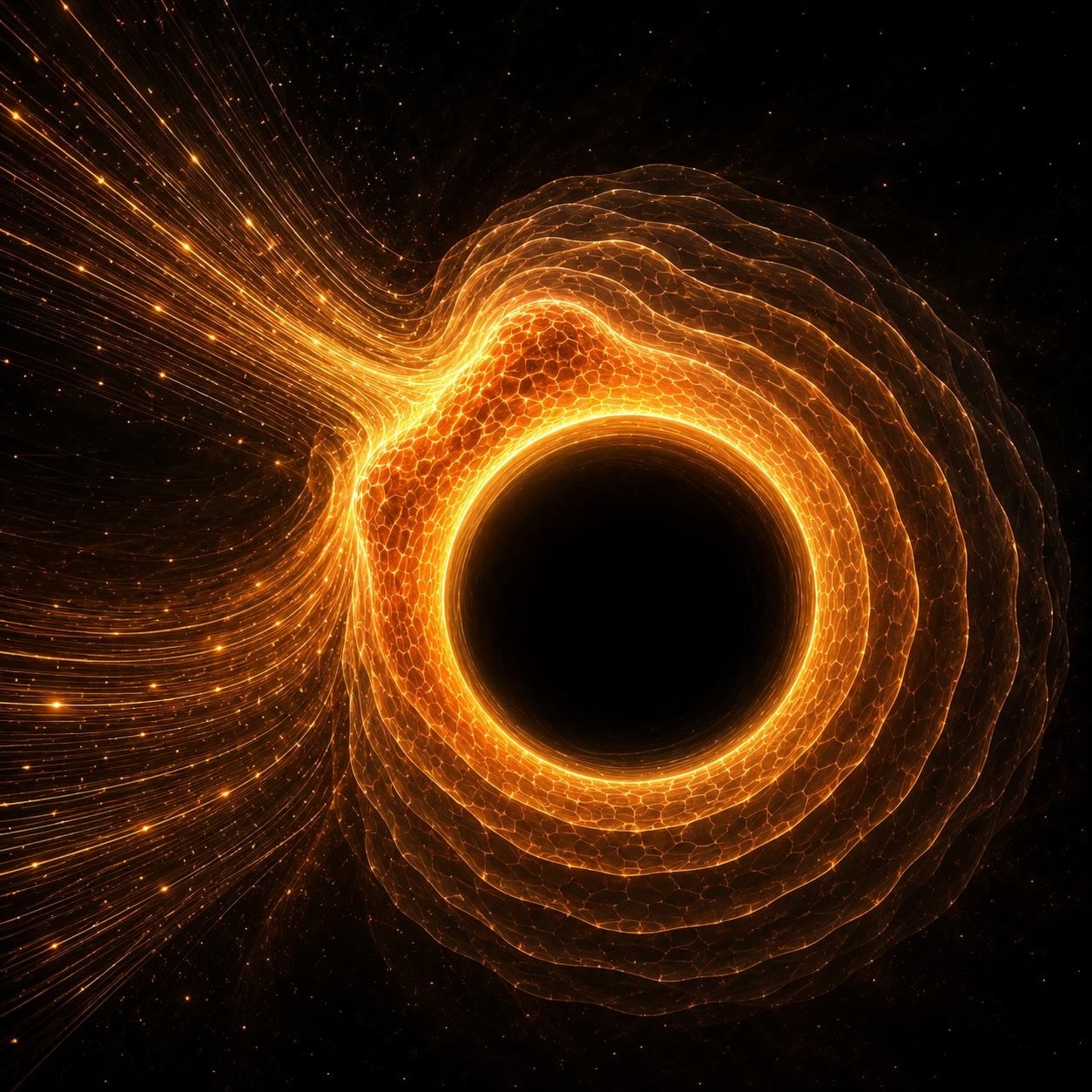
Black holes don’t sit still.
They churn. They eat matter. They smash into each other and eventually evaporate into nothingness. For half a century, physicists treated them as if they were static, unchanging rocks at the end of the universe. That’s wrong.
A new study out of Penn State has cracked open thermodynamics of black holes far from equilibrium by ditching old rules for something that actually fits reality.
The old rules only worked on frozen black holes
Here’s the thing about black holes. They are extreme. Crushing gravity. Zero escape.
In the 1970s Stephen Hawking showed us something weird. Black holes obey the laws of thermodynamics. The same rules that dictate how ice melts or coffee cools also seem to govern these cosmic pits.
But there was a catch.
“Hawking’s laws… have a serious limitation,” says Abhay Ashtekar. He leads the team at Penn State. “They were formulated for black hole at equilibrium. Unchanging over time.”
Real black holes never stay like that.
They form. They merge. They fade away.
The old math worked perfectly for a hypothetical black hole that sits alone and does nothing. But the universe doesn’t hand those out.
Why event horizons lie about entropy
Entropy measures disorder. The Second Law of Thermodynamics says it never decreases. In black holes Hawking said entropy was tied to the surface area of the event horizon. That boundary is where gravity gets too strong for light to escape.
It sounds simple. It’s not.
The problem? The event horizon is teleological.
That means its shape depends on the future. Not the present. To know where an event horizon is right now you’d have to know every thing that falls in or explodes later on. That makes no sense for tracking physics in real-time.
“Properties cannot be determined just by local physics,” explains co-author Jonathan Shu. “Instead they rely on prediction of events.”
So you can’t use it to measure the physical entropy of dynamical black holes. The metric breaks down the moment things start moving.
Dynamical horizons solve the timing problem
The fix involves swapping out the event horizon for something else. Enter: dynamical horizons.
These aren’t theoretical ghosts. They’re defined by physical properties at a single moment in time. No need to predict the future.
The new approach links entropy directly to two things.
1. The black hole’s energy.
2. Its spin.
It’s cleaner. More realistic.
“We can apply these generalized… to better understand evaporating… and black hole mergers.” – Ashtekar
This matters because we see those mergers all the time. Gravitational wave detectors like LIGO pick up the ripples. But without accurate thermodynamics we can’t fully parse the data. We’re listening to a conversation we don’t have the words for yet.
Does this change how we see gravity?
Probably.
Daniel Paraizo one of the authors points out the shift. Earlier models treated black holes as having zero temperature and infinite entropy. They absorbed energy and gave nothing back. Pure vacuum cleaners.
Then Hawking radiation changed that. Black holes leak energy. They have temperature. But the old equilibrium laws couldn’t track that leakage smoothly.
Now with dynamical horizons you can trace the life of a black hole. From formation to merger to evaporation. One continuous thread of physics instead of a series of disjointed snapshots.
It’s not magic. It’s just math that finally admits change is normal.
Will it explain quantum gravity? Maybe. For now it just lets us stop pretending black holes are frozen in amber. They’re alive in the sense that physics cares about life: changing systems.
What happens next depends on how well the simulations hold up.