



Every child in America grew up playing with See ‘n Say®. It speaks when you pull the tab. No battery. No buttons to jam. Just mechanical noise.
Classic models are based on a simple drawstring mechanism. The latest version uses leverage, but the result is the same. Orient the selector to the picture. You pull. The toy talks.
I’ve seen these things survive in things they were never meant to endure. Immersed in the bathtub? Fine. Thrown down concrete stairs? Still works. Have you repeatedly dropped it on a hard patio? No problem. They are almost indestructible. they have been around forever.
But have you ever stopped and thought about design?
It sounds like magic, but it’s physics. How can a piece of plastic fit 26 different sentences? How can it produce sound without using a single joule of electrical energy?
Let’s break down the See ‘n Say sound mechanism to understand exactly how it works. This is a marvel of analog design. The mystery is solved.
History
See ‘n Say was introduced in 1964 by Milton Bradley. It was designed by a man named Ed Krall. The goal was simple: to create a toy that teaches children about animals and their sounds. But it has to be cheap. Durable. And battery-free.
Before See ‘n Say, toys required electricity. Or they were static. This toy is different. It is interactive. And it relied on a clever use of stored energy.
The drawstring mechanism is the key. When you pull the string, you wind a spring inside the toy. This spring stores potential energy. When you release the string, the spring unwinds. This unwinding drives a gear system. The gears rotate a cylinder. The cylinder has raised bumps. These bumps are called cams.
As the cylinder rotates, the cams press against a reed. The reed vibrates. This vibration produces sound. But how does it select which sound to play?
This is where the dial comes into play. The dial is connected to the cylinder. When you turn the dial, a different set of cams align with the reed. Each set of cams corresponds to a specific phrase.
The expression “the cow says moo” is encoded in the shape of the beak. The shape determines the timing and pitch of the reed’s vibrations. It is a crude form of synthesis. But it works.
See ‘n Say was a hit. Millions of units were sold. It has become a cultural icon. However, its simple appearance hides a complex mechanical system. A system that we will explore in detail.
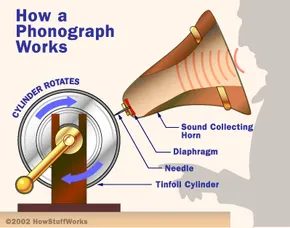

It starts with tin foil and a needle. In 1877 Thomas Edison introduced the phonograph. This phonograph is a machine that captures sound by physically etching it into a rotating cylinder. There were no magnets or electricity, just pure mechanical force. You talked to a funnel. A diaphragm vibrated. A stylus scratched your voice into the wax or foil. To hear it, the needle followed the same jagged line, causing the diaphragm to vibrate and repeat the sound. It was analog. It became the basis for everything that followed.
Emil Berliner changed the game in 1887. He replaced the cylinder with a flat disk. The gramophone used spiral grooves on a flat record, a design choice that greatly facilitated mass production. This technology was still completely mechanical. No electronics yet. All you need is a needle, a diaphragm and physics.
Decades later, the same mechanical logic ends up in the plastic hands of children around the world.
See ‘n Say
The classic See ‘n Say toy is basically a gramophone for toddlers. The exact same mechanical principle is used as perfected by Berliner. When the child turns the handle, the crank turns the plastic disc. A needle rests against the surface. The disc has pre-etched grooves that correspond to different pictures or phrases.
No battery. There is no circuit board. No speaker cone driven by an electrical signal. When the needle hits the groove, the physical vibrations inside the plastic cause small vibrations in the membrane. This vibration directly produces sound waves. This is a direct conversion from mechanical to acoustic.
This gives the sound a very unique and tinny quality. It isn’t recorded in a studio and played back through a speaker. The sound is amplified only by the shape of the plastic case. The groove itself is the recording. The needle is a playback head. The child’s hand provides the energy.
This is a fascinating piece of engineering history wrapped in bright primary colors. When you turn the knob, the needle moves along the groove and a voice (recorded decades ago with a human actor and now encoded as a physical ridges in plastic) speaks to you. No electricity is needed. Just pressure and friction.
Its simplicity is almost deceptive. You might think there is a small motor or chip inside. But take a closer look. This mechanism is the same as the gramophones that once filled parlors in the late 19th century. The media has changed from tin foil to vinyl to plastic, but the core concept remains the same. The needle reads the grooves carved into the material and produces a sound.
Why did manufacturers continue to use this method long after the advent of tape and digital audio? Cost. Durability. Simplicity. A plastic disc doesn’t demagnetize. It doesn’t tangle. No need to charge. It just works. The See ‘n Say became an icon not because it was technologically advanced, but because of its mechanically pure. Connect children to the legacy of Edison and Berliner by shared physical action. Turn. listen. repeat.
The sounds you hear are literal. The ridges in the plastic are sound waves. If you zoom in on the groove hard enough, you can see the actor’s waveform.


Forget digital files and microchips. The magic behind that iconic plastic toy lies in a plastic disk that functions exactly like an old-school gramophone record. There is no battery-powered speaker driving the noise. Instead, a track containing the sound wave for each of the toy’s noises is physically embossed into the disk.
Most See ‘n Say models hold between 10 and 26 distinct sounds. You won’t find these scattered randomly. They are stored in concentric tracks that spiral inward from the edge.
How to Find the Right Groove
If you look closely at the edge of the disk, you can spot the starting points for each concentric track. This is where the mechanical logic of the toy takes over. The user doesn’t press a button to skip tracks in the traditional sense. You align the mechanism with the specific starting point for the image you want to hear.
From Groove to Cone
Sound reproduction here is brutally simple. A metal needle rides directly in the selected groove. As the disk spins, the needle vibrates. These vibrations travel without amplification. They are transmitted directly from the needle to a plastic cone speaker. The physics are old, but the result is loud, clear, and undeniably nostalgic.
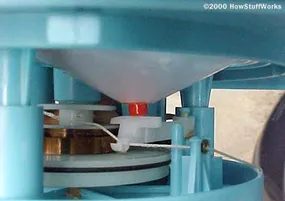

The needle fits into a T-shaped plastic piece. It captures the vibration pattern engraved on the disc and sends it to the T, where the signal is sent through a red plastic tip to the cone. that’s it. When See ‘n Say talks, you hear pure mechanical vibration. There is no electricity. No chips. It’s just plastic hitting plastic.
Pull the rope. This raises the needle and pulls it back to the outer edge of the disc. The drawstring can also be wrapped around the brass spring. The energy stored in the spring rotates the disc and produces sound. Simple. Brutal. Effective.
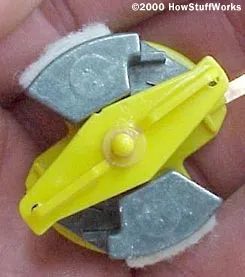
The only other component of See ‘n Say is the Governor which is very well done. Adjusts the disc rotation speed. In the picture below you can see the belt wrapped around the disc and the governor shaft. This is a bit of engineering to prevent playback from speeding up or slowing down. Without this, the sound will be muddy.
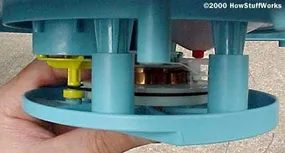


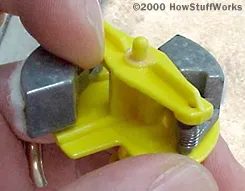

Classic mechanism
The governor is the unsung hero here, the brains of a machine consisting of two spring-loaded weights. Let’s see what happens when the disk speed increases. The weight flies outward and presses against the cylinder wall. Friction is starting to appear. The speed of the disc slows down. In the balance mode, the speed controller maintains the exact rotation speed required for accurate note reading. This is the physics of self-regulation.
That’s all the secret. See ‘n Say is based on three parts: an embossed plate, a metal pin and a plastic cone speaker. Pull the rope. The spring winds. The spring rotates the disk. The governor controls the speed. No battery. No circuits. It’s just mechanically simple. This explains why it continues to work even after a bath. You can tighten it again tomorrow.
We live in the era of battery-powered toys. The built-in microprocessor can now generate sound. Think of a singing fish. Digital files. Code. Algorithms. Classic See ‘n Say rejects all of this. It uses 19th century technology to create something virtually indestructible. A toy that transcends trends. It goes on and on.
Related blog posts
- How the speaker works
- How analog digital recording works
- How the guitar works
- How Magna Doodle works
- How does an Etch-a-Sketch Work?
- How Yo-Yos Work
- Can you really have a long distance conversation with two cans and a string?
More attractive links
- Fisher Price See ‘n Say
- 1960s See ‘n Say commercials
- Toy of the Year Awards


