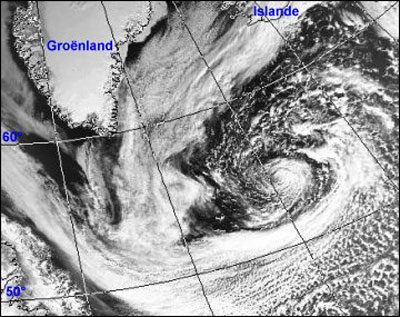
The gulf stream is more than just a warm stream. It is the central nervous system of the western Atlantic Ocean. It was formed by water gushing from the Gulf of Mexico off the coast of Florida and is divided into meandering sections. These parts move east and northeast, carrying heat across the ocean.
This trend is part of something bigger. The climate system is a machine. Its task is to convert and distribute the energy coming from the sun. The sun is the only source. Everything else just works. Continents absorb solar energy. They release it into the atmosphere with varying intensity depending on the ground surface and vegetation.
Next is the cryosphere. This applies not only to sea ice, but also to the Greenland and Antarctic ice sheets. Ice reflects energy back into space. This is energy lost from the climate system. This reflection depends on the ice conditions and the amount of surface it covers.
The sea and the atmosphere are the real stars here. These are the two fluids that transport heat from the equator to high latitudes. They interact. They exchange energy endlessly. They are inseparable. This pair controls the Earth’s climate on the time scales that matter to us.
However, it is difficult to model them together. they have different characteristics. They develop at very different rates.
The climate system strives for a balance that can never be achieved. It is constantly changing on all time scales.
The atmosphere is highly variable. It reacts quickly to disturbances. It grows fast. A low pressure system in the North Atlantic crosses the ocean in just two to three days. Its entire life cycle lasts about a week.
This speed makes weather forecasting difficult. Meteorologists currently offer a seven-day forecast. There are better atmospheric models, but they still have limitations. There is a horizon beyond which prediction is impossible. At that point, the state of the atmosphere is completely independent of its initial conditions. This period can last about 15 days.
Why is this important? Because the ocean moves much slower. It takes decades or centuries for the Gulf Stream and other deep water currents to change. As the atmosphere changes rapidly, the ocean is left behind. This delay causes instability. We are in a constant state of adaptation.
The system is always trying to balance itself. It will never be static. That’s enough for people. As long as change is acceptable, we can survive. But stability is an illusion. This is temporary.
How does this affect your daily life? Tomorrow’s weather will be determined by short-term atmospheric disturbances. The climate you experience over a decade is determined by the slow drift of the ocean. The Gulf Stream is a bridge between these two worlds. As the velocity decreases, the atmosphere must adjust. It’s not done elegantly.
We depend on the stability of the system. We build cities and farms according to predictable seasons. But the sea is changing. The ice melts. The heat distribution changes. The machine still works. It just feels different.
Is there a breaking point? Scientists don’t know yet. Models are getting better all the time. However, atmospheric forecasts still have limitations. We’ll find out next week. We cannot look to the next decade with the same confidence.
The Gulf Stream continues to the east. It doesn’t care about for predictability. It just follows physics. Physics has nothing to do with our timeline.
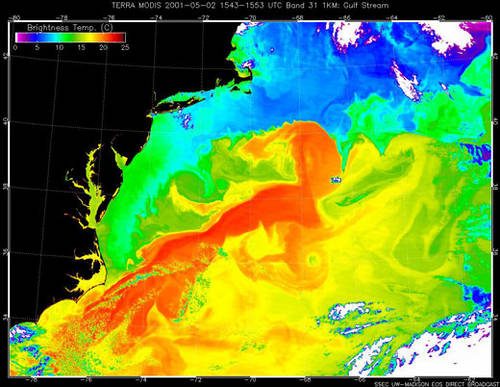
How #oceanicremembers climate patterns outside of weather
The sea moves slower than the air. It’s much slower. Thanks to this delay, your memory will improve.
For a visual inspection, see Figure 2 of the source material. Surface temperatures in systems like the Gulf Stream vary depending on the duration of the glaciers. On the other hand, ocean eddies (mainly low pressure systems in the deep ocean) can last for months. In some cases, it can take more than a year. It is not a fleeting event. They are long-term residents.
This slow state gives the ocean two roles. First, it transports some of the energy directly into the atmosphere. Second, it acts as a conveyor belt for the planet, distributing the remaining heat around the world through ocean currents. At any location, the amount of energy exchanged between water and air is determined by one number: the surface temperature. Its temperature is simply the cumulative result of all the heat the ocean has carried so far.
When does the ocean really matter?
This is where the rubber meets the road of prediction.
The complexity of the sea becomes noise when trying to predict rain 14 days from now. The vortex dynamics below do not need to be modelled. On this short time scale, changes in ocean surface temperature are too small to significantly alter energy exchange. Weather models can definitely avoid atmospheric effects. They only see the surface. They calculate the flux. That’s the end for them.
But look further.
On a climate scale, the situation is just the opposite. The sea becomes your partner in setting the pace. This person is a slow-moving system. In a system dominated by inertia, slow movers determine the pace of change. You can’t ignore it.
Long distance connection
This is why climate models are fundamentally different from weather models.
Weather patterns often vary. They considered the sea as a static boundary condition with slowly varying surface temperatures. Climate change models do not have this luxury. Whether the specific simulation period is 5 or 50 years, ocean and atmosphere dynamics must be coupled.
Why? Because the ocean imposes its rhythm on the climate system. If you exclude the ocean, you’re simulating a planet that doesn’t exist. You are ignoring the main heat storage and vast redistribution networks that define our actual climate reality.
“On the climate scale… the slowest partner is the ocean, which imposes its own rhythms on climate.”
So the next time you hear a “slow” signal, don’t ignore it. This delay is a signal. This is Earth’s memory waiting to influence what happens next.
Media myths and the maritime reality of Gulf Stream
The media loves Gulf Stream. It attracted a lot of attention. But this spotlight is misleading.
You saw the title. I read the dramatic description. They imagined ocean currents as giant rivers of warm water flowing through the Atlantic Ocean. Sounds very cinematic. We sell magazines.
This is not entirely correct.
The reality is more disturbing. It’s even more complicated. The sea does not move in a straight line. It is spiral shaped. Twisted. Stirred.
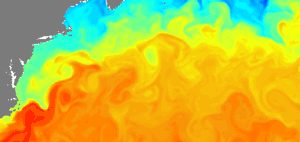
Mercator Group’s high-resolution models are changing the way we think about this. You don’t just see the blue band on the map. Detailed temperature information is displayed. The result is a chaotic vortex and a meandering vortex. It is not a steady flow. noisy dance
Why does distortion matter?
We think of Gulf Stream as a conveyor belt. Assume it is constant. This assumption hides the truth about ocean dynamics. Ocean currents participate in the larger climate system. It plays its part. But it doesn’t dominate the layer. It’s a part.
Media reputation overshadows science. The highway to warm water comes to mind. In fact, the current hub is round. It creates a vortex. These properties transport heat, salt and nutrients in unpredictable ways. Ignoring this complexity makes climate prediction even more difficult. This makes understanding local weather patterns even more difficult.
Read the real data
The Mercator projection beats the hype. They are solution-oriented. The high resolution means you can see even the smallest details. That little swirl. sharp bend. These are not just visual features. Functional parts of marine systems.
Temperature gradients reveal structure. When cold and warm meet, sharp lines appear. You can see that the main current is divided into lower energy cells. This is the real movement of water.
Why do we care? Because these eddies stir the ocean. They affect the movements of sea life. They affect carbon storage. They determine how quickly heat travels from the tropics to the polar regions. Flattening the data into a simple layer eliminates this mechanism. We lose cause and effect.
A hidden mechanism
The “river” metaphor fails because rivers have banks. Not so at sea. The Gulf Stream is defined by density differences and wind forces. Unstable and tortuous. There is a possibility of damage caused by friction.
This is not a fault. This is a function. Mixing requires chaos. Without these turbulent interactions, the ocean would have stratified. It has stopped. It becomes less effective at regulating the Earth’s temperature.
We have to stop thinking of Gulf Stream as a static entity. This is a dynamic system within a dynamic system. Media images are caricatures. The scientific model is a mirror.
Let’s look at the temperature chart again. Look for eddies. Find your breaking point. This is a true layer. It’s not in the title. In the data.
Gulf Stream does more than just move water. It breathes. transfers. The shape changes every day. Breath measurement is just the beginning.