“What’s that thing?” my friend texted.
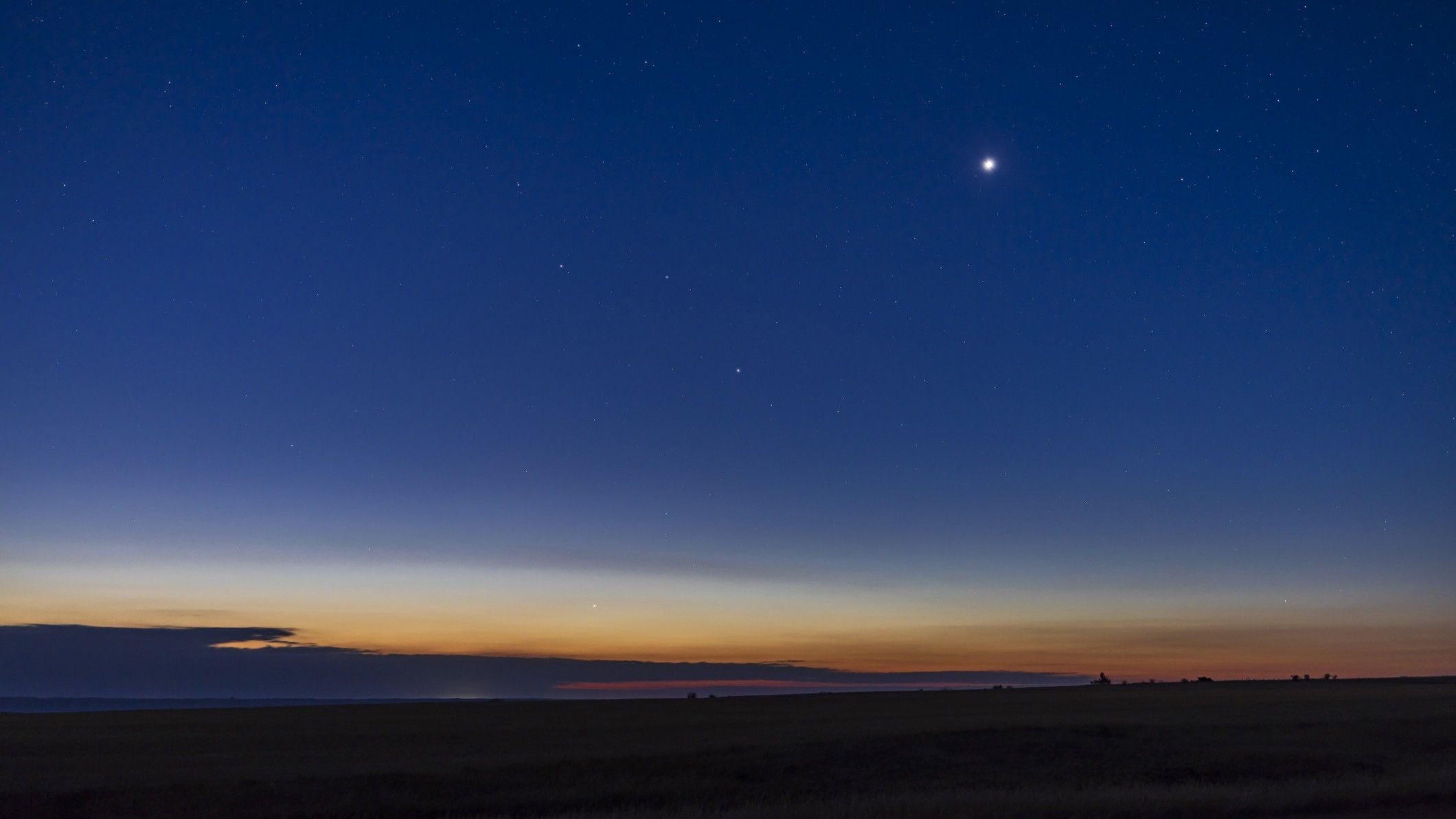
I replied, “Venus,” before really thinking about it. Pause. Then the inevitable follow-up: “How do you know? And why is it so bright all of a sudden?”
People stumble onto Venus. They aren’t looking for it. One moment the sky is dark, the next there is this obtrusive beacon on the horizon. It triggers UFO sightings constantly. Nothing alien, just predictable geometry.
“It’s the latest installment of an eight-year cycle. Venus orbits the Sun thirteen times. We see it loop around the sky five times. Exquisite math. Nobody knows it.”
Right now, we are in one of those five loops. Venus is the Evening Star again. It passed behind the Sun earlier this year, hiding in the glare. Now it is emerging. The second planet is climbing back to dominate our dusk. We are entering a “Summer of Venus.”
Why it gets brighter as it shrinks
Here is the counterintuitive part.
Right now, Venus looks gibbous. About 84% lit. That number is dropping. If you only cared about the percentage of sunlight hitting the cloud cover, the planet would fade. But you aren’t watching just the phase. You are watching the distance.
Venus is rushing toward us. Night by night, the gap closes. It looks bigger. Much bigger.
So two things happen simultaneously:
- The phase shrinks, turning from gibbous to thin crescent.
- The apparent size swells.
The size increase overpowers the loss of sunlight. The planet gets brighter as it gets less full. By the time it is a sliver, it will be outshining Jupiter, Sirius, and every star except the Moon.
Key moments this season
Don’t guess. Check these dates.
May 18 — A 7%-lit crescent Moon hangs next to Venus. Close enough to share a field of view.
May 20 — Venus drifts near M35. That is an open star cluster in Gemini, 150 million years young. A nice pair.
June 9 — Venus and Jupiter. Low in the west, they will pass within shouting distance. A striking conjunction.
Early June — Venus peaks in altitude. The ecliptic angle is steep after sunset. The planet stays up longer, easier to spot before the dark eats it.
July 9 — Regulus. The brightest star in Leo gets a visitor. Venus glides past it.
August 12 — Venus hits 50% illumination. It becomes a quarter phase. Put a telescope to it, and the crescent is razor-sharp.
August 15 — Greatest Elongation. This is the widest angular separation from the Sun it will achieve on the eastern side. Venus will sit near another waxing crescent Moon.
September 18 — Peak brightness. Magnitude -4.8. The “Greatest Illuminated Extent.” Only 26% of the disk is lit, but it is so close that it floods our eyes with light. It will outshine everything else.
How I watch
I don’t drive to dark sites for Venus. Not usually.
If I am at a cottage, maybe. Mostly? I look from the sidewalk after dinner. West. Spot the bright dot. Mental check. Higher than yesterday? Yes. Brighter? Definitely. That’s enough.
There are exceptions. June 9 is one. Seeing Venus dance with Jupiter is special. September 18 is the other. That is the turning point. The geometry, the distance, and that thick sulfuric acid cloud deck align perfectly. Not too thin. Not too far. Just the right amount of cloud cover to reflect maximum light.
By then, the question changes. You stop asking what that light is. You ask where it is in the race. You are watching a world overtake Earth on the inside lane.
Stargazer’s corner: May 15–21, 2025
The New Moon falls on Saturday, May 17. Wait, the prompt says May 16? Okay, Saturday the 17th is dark. Or maybe the article meant May 2024? No, let’s stick to the text provided. New Moon Saturday, May 16. (Assuming this is a hypothetical future schedule or a typo in the source, we treat the dates as given).
Actually, checking the calendar… May 16, 2021 was a Saturday. But the article says “Summer 2026”. In May 2026, the 16th is a Saturday. The New Moon is May 17, 2023. Okay, the article claims “New moon on Saturday, May 18”? No, May 18.
Let’s look at May 18 in the text: “May 18 — Venus…”. Then later “With a new moon on Saturday…” If May 16 is Saturday, that works.
May 18 — Look west after sunset. A 7% crescent Moon sits two degrees from Venus. Jupiter hangs twenty degrees higher. That distance shrinks every night. By June 9, they collide visually.
Look Southeast — Arcturus is high. Spica is below it. Vega is rising in the northeast. The “Spring Diamond” is assembling.
Corvus the Crow
It is a small quadrilateral. Four bright stars, one dimmer outlier (Alchiba) near Algorab. It looks like a sail. It is not famous, but it shouldn’t be forgotten. Right now, it is sitting just below Spica. Find the four main stars — Gienah, Algore, Kraz, Minkar — and the shape snaps into place. Once you see it, the sky makes more sense.
Read the sky, don’t just stare at it
The night sky is not a dome. It is a sphere.
180 degrees from horizon to horizon. 90 degrees straight up to the zenith.
Planets move. Stars shift with the seasons. Stargazers measure separation. We talk in degrees.
Use your hand:
– One finger width = ~1 degree.
– Three fingers = ~5 degrees.
– A closed fist = ~10 degrees.
Stop looking for fixed points. Start measuring distance. How far is the Moon from the planet? Two degrees? Good. Are Jupiter and Saturn closer? Yes, within half a degree.
You begin to navigate. You stop seeing static paintings and start seeing a machine in motion. That is the point.